
The Quarterly Report Card is a snapshot of student performance for that academic quarter. It reports the final, official grade for that academic quarter and, other than in extreme cases, cannot be changed. The Quarterly Report Card is a useful planning tool for creating academic plans/strategies for the following quarter(s).
What to look for:
School Information:
At the very top of the Quarterly Report Card, the School Name, School Number, and Address will all appear. This information is useful for contacting the school as well as obtaining information through the Baltimore City Public Schools website. If the enrollment information is not correct (as time may have lapsed), please reach out to Thread to ensure correct enrollment is confirmed.

Heading:
This section lists out the Student Name, Student ID Number, Current Grade Level, Graduation Year Cohort, and School Counselor for the current school year. If any of this information is inaccurate, students should flag for the school. Thread staff can assist in connecting with the correct personnel at the school and getting information changed.

Enrolled Courses:
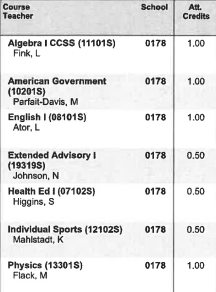
All enrolled courses should appear in the main body of the Quarterly Report Card. The only exception of some courses being taken in credit recovery (e.g. Apex). These courses may appear with no entered grade (because they do not follow the quarterly schedule) or may not appear at all until a final grade is earned for the course. The name of the course, course code, school number, and credits being attempted should be listed.
*Pro tip: When looking at the course code, the letter at the end (S, Q, Y) refers to the length of the course (S=Semester, Q=Quarter, Y=Year).
Quarter Grades:
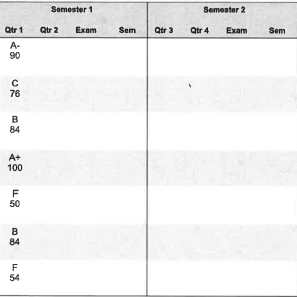
All final quarter grades should appear with the corresponding courses. Where is the student excelling? Where could the grade use a bump? Are there any courses that are failing grades? Are there any trends? Are there any anomalies (e.g. are there four passing grades and two failing grades)? Some Quarterly Report Cards also include the Progress Report Grade (snapshot of the grade for the course midway through the quarter), as well as other quarterly grades, exam grades, and semester grades.
Period Absences and Teacher Comments:
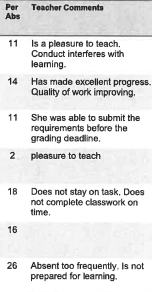
The number of absences recorded per period can be very telling as to why the quarterly grade was earned. This provides insight beyond the general daily attendance. Are there classes that were missed more than others? Where does that class fall in the schedule (typically the most frequently missed classes are First Period, Last Period, and the period right after lunch). Teacher Comments offer further insight into the student’s performance in class. Often comments include: “Pleasure to teach,” “Regularly contributes to class discussions,” “Absent too frequently,” “Parent conference requested”. These comments, along with period attendance, can be key in developing an academic plan and setting academic goals.
YTD Attendance:
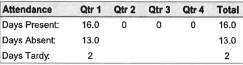
The Year-to-Date Attendance will show the official attendance record for the quarter. It will list total days present, total days absent, and the number of tardies. Again, this is a useful tool–along with period attendance–to set goals and to come up with strategies to maintain or improve attendance. Subsequent report cards (Q2 - Q4) will include the daily attendance from previous quarters as well.
Service Learning Hours:
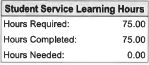
The Quarterly Report Card will show the total number of Service Learning Hours earned at the Quarter end-date. Totals are updated quarterly. This can be used to make a plan for earning remaining hours and timeframe to do so, depending on targeted graduation date, or to confirm that all hours have been completed.
Cumulative GPA:
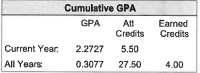
This section will show the current Grade Point Average, the Grade Point Average for all years, the current number of credits being attempted, the total attempted credits for all years, and the total earned credits. GPA is not a graduation requirement, but can impact acceptance to college/university or other programs, eligibility to participate in sports or other extracurricular activities, etc. Attempted and earned credits are another way to look at timeframe for graduation.
*Pro tip: Earned credits do not always equate to required credits. Often students earn more than the required 21 credits as they take additional elective, technology, arts, or other credits. To determine the number of required credits earned, the student Transcript, Graduation Status Report (GSR), School Counselor, or Thread Staff should be consulted.
Grading and GPA Weighting:
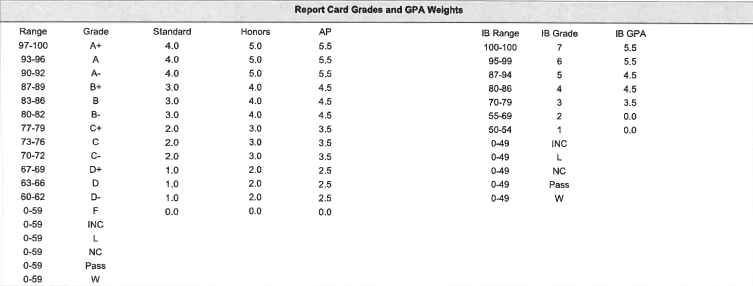
The grading scale will appear at the bottom of the Quarterly Report Card. It gives the ranges for number and corresponding letter grades. It also shows how different courses (e.g. Advanced Placement (AP) and International BaccaLAureate(IB) are weighted). Do you have a question about what constitutes a passing grade?--consult this section.
*Pro tip: The minimum passing grade for all courses is 60% (D-). The lowest grade that can be earned and will appear on a report card as a quarterly, exam, semester, or final grade is a 50% (F).
Comments
0 comments
Please sign in to leave a comment.